Tone in a Bantu language is not decoration. It is not stress. It is not emphasis. It is meaning. Change the tone on a syllable and you do not get the same word said with feeling — you get a different word. A different statement. Sometimes a different sentence altogether. Across 500+ Bantu languages, tone is one of the load-bearing layers of the grammar.
But tone has to live somewhere. It does not float in the air. It is not painted onto the letters of the orthography — the colonial-era spelling system never had a way to mark it. Tone in every Bantu language lives in exactly one place: the syllable. The syllable is the Tone-Bearing Unit. So if a frontier model cannot enumerate the syllables of a language, it cannot find the units that carry the tone. And without those units, it cannot do tone.
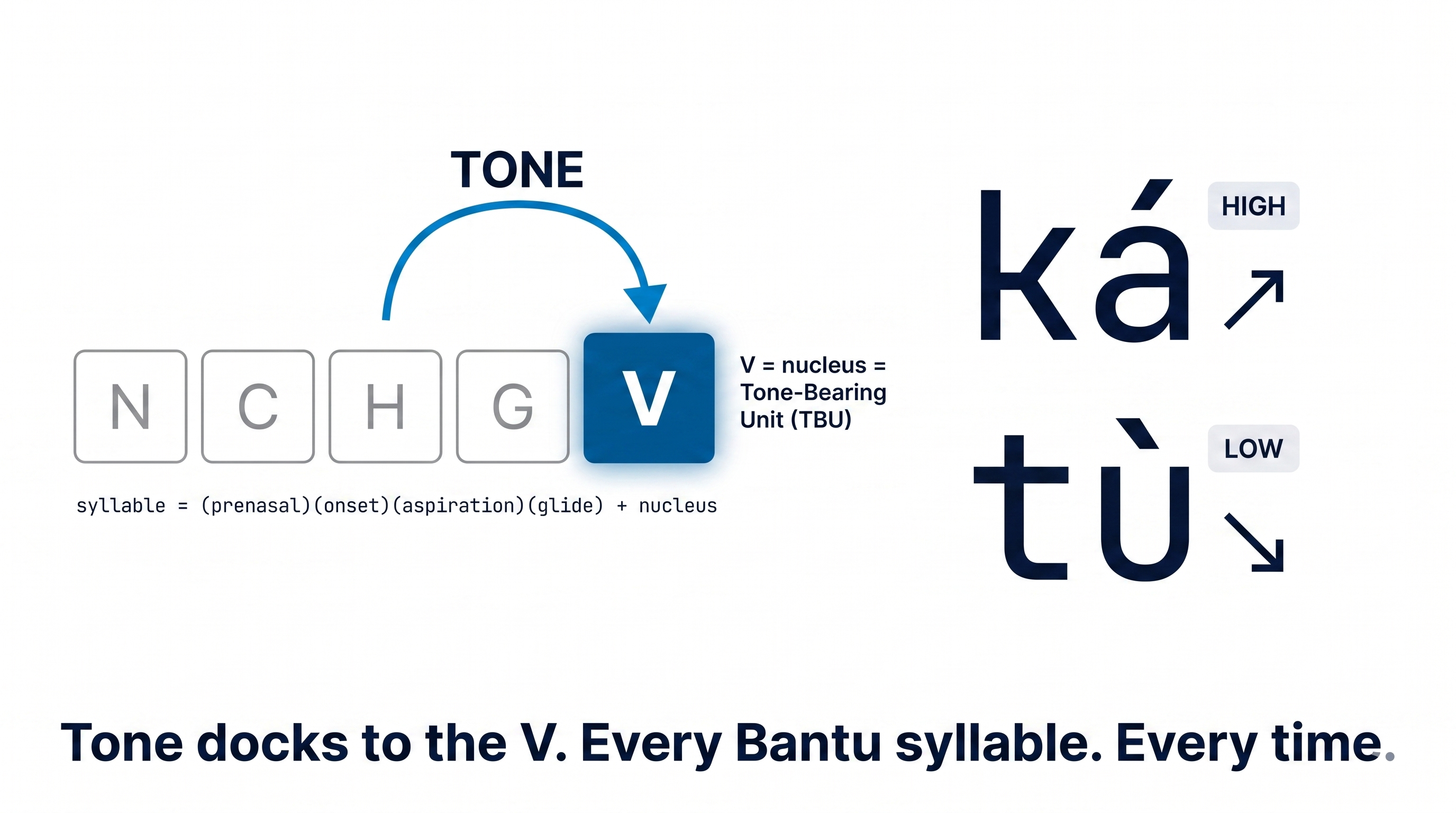
None of the frontier LLMs can tell you the full syllable inventory of any of the 500+ Bantu languages. And if they don’t know the syllables, how can they understand tone — when the syllable is the tone-bearing unit?
Tone attaches to the V. Every time.
A Bantu syllable, across every member of the family, has the same template:
| Slot | Name | Example | Carries tone? |
|---|---|---|---|
| N | Prenasal | mb, nd | no |
| C | Onset | k, t, b | no |
| H | Aspiration | pʰ, tʰ | no |
| G | Glide | w, j | no |
| V | Nucleus TBU | a e i o u | YES — always |
Walk through a four-syllable Bemba word: u-le-bo-mba. Four syllables. Four V slots. Four places where tone can dock. Tone, vowel length, downstep, phrase-boundary signals — all of them attach to that V. They never attach to the morpheme. They never attach to the letter.
The same is true of every word in every Bantu language. The slots (N)(C)(H)(G)V are universal across the family. The V is the only slot that ever carries tone. No syllable, no V. No V, no anchor for tone.
Different tone, different word.
Take the syllable le in Bemba. On the page it is two letters — an l and an e. In the air it can be five different things, distinguished only by the tone the speaker puts on the e:
Most Bantu languages use a 3-level tone system (High, Low, Mid). Some use 4. Some add rising or falling contours. The exact inventory varies by language — but the attachment point never varies. Tone always lives on the V of the syllable. Always.
And tone is meaning-bearing. Where English uses tone for emotion (“really?” vs “really.”), Bantu languages use tone for the dictionary entry. Two words spelled identically can be two completely different concepts. The same string of letters — ulebomba — can be ten different statements, distinguished only by tone and vowel length distributed across its four syllables.
The cascade.
Here is the chain of dependencies. Each step is forced by the one above it:
-
1.Meaning in Bantu is decided by tone. Different tone, different word.
-
2.Tone attaches to the syllable nucleus (V). Never to the morpheme. Never to the letter. The syllable is the Tone-Bearing Unit.
-
3.To find the V you must first find the syllable.
u-le-bo-mbais four syllables, not eight letters. -
4.To find the syllable you must have the language's Full Syllable Inventory — the closed, enumerable set of legal syllables. Without it you cannot tell where one syllable ends and the next begins.
-
5.In 2026, no frontier model has the FSI of any Bantu language. They have BPE token fragments. That is not the same thing.
A model that cannot enumerate the syllables of a Bantu language cannot find the units that carry the tone. A model that cannot find the units that carry the tone cannot recover the meaning. The syllable failure and the tone failure are the same failure.
Why this fact gets missed.
Three reasons frontier labs miss it.
The Bantu orthography on the page does not mark tone. The page looks complete — the same way English text without intonation marks looks complete. A model trained on that text has no way to know that the tone layer exists, let alone that it carries the meaning.
When a tokeniser splits ulebomba into ule+bom+ba, the output looks syllabic. It is not. BPE optimises on character-frequency in a corpus. Bantu syllables optimise on phonotactic legality. The two coincide only by accident, and they diverge on every prenasalised, labialised, or palatalised onset — the rows where our benchmark shows the worst failures.
A model cannot “see” tone the way it can see a syllabary on a blackboard. Tone is a property of the audio signal — pitch contour over time. Without the audio, and without the syllable boundaries to time-align the audio to, the model has nothing to attach the pitch to.
The fix.
The fix is the same fix the rest of this site argues for. FSIs are not data — they are infrastructure. Index your tokeniser into the FSI. Get syllables, not BPE fragments. With syllables in hand, the V slots are addressable. With the V slots addressable, tone has somewhere to dock. With tone docking, the model recovers what the orthography drops.
This is not theoretical. The Amina recording pipeline already aligns 48 kHz native-speaker audio against the FSI syllable boundaries. The tone annotations dock to each V. The full layer is recoverable — once the substrate is in place. BABS rewards models that get this right. Today none does.
Syllables are the heartbeat of Bantu languages. They carry tone. They carry meaning. They carry our identity.
Protect the syllables. Preserve the tone. Build the substrate. Until a frontier model has every Bantu syllable inventory it claims to support, “tone-aware Bantu” from any AI lab is a marketing claim — not a phonological one.