When I was five years old, I was not given an alphabet. I was given a syllabary. Every Bantu child is. The unit of Bantu literacy — from Swahili to Zulu, from Bemba to Shona, from Lingala to Kinyarwanda — is the syllable, not the letter.
This single fact is what every frontier multilingual model gets wrong. They tokenise Bantu with BPE, the same way they tokenise English. They never learn that the atom of meaning is the syllable. By age six, a Bantu child anywhere in the family has internalised their syllabary. In 2026, not a single frontier LLM has.
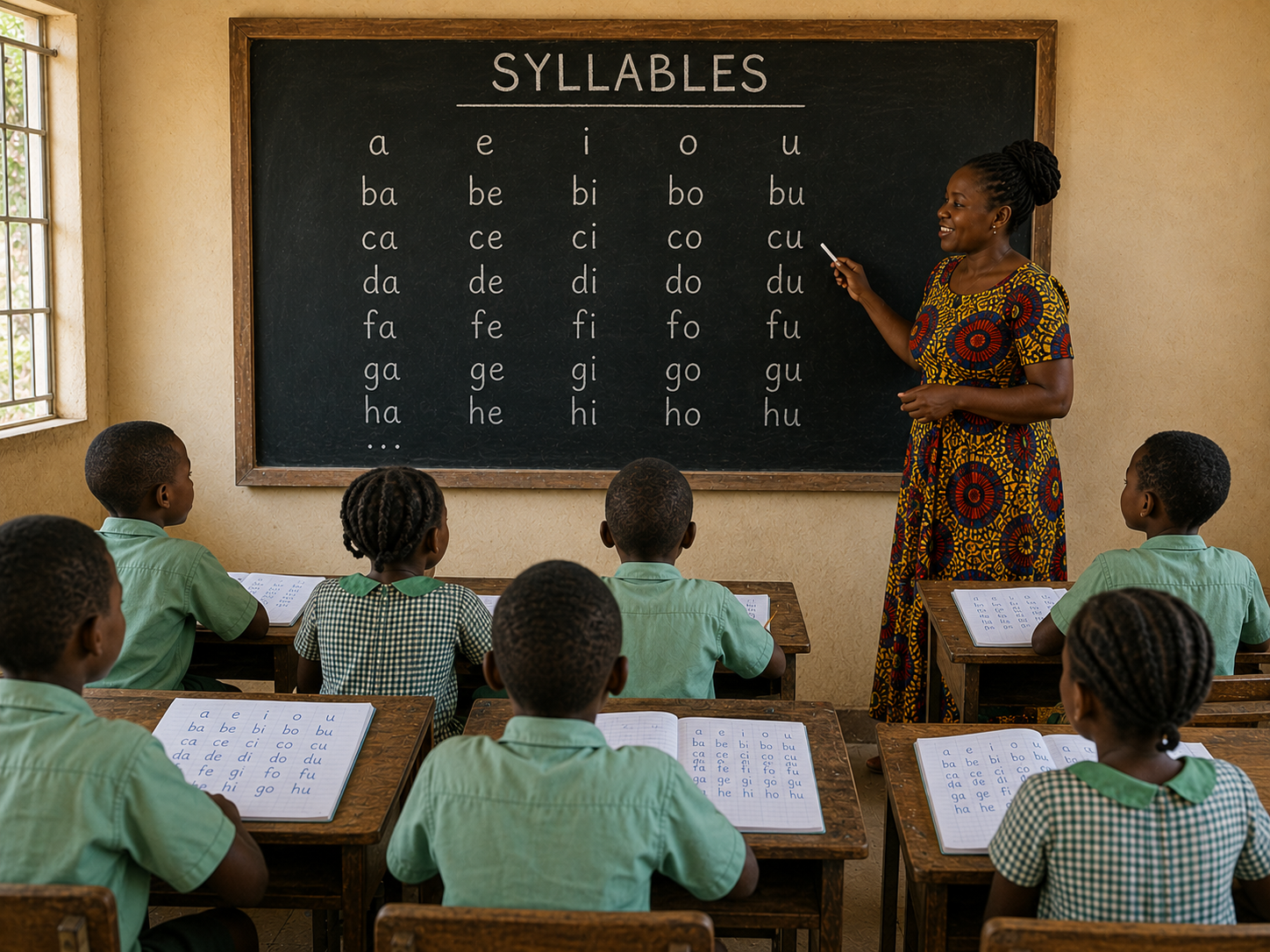
SYLLABLES on the board, the grid running from a·e·i·o·u down through ha·he·hi·ho·hu. The children are copying it into their workbooks — one syllable, one look, one sound at a time.
This is what the work looks like. Watch carefully: when the child learns what each syllable looks like and what each syllable sounds like, they are not learning two separate things. They are literally learning to read, to pronounce, and to write the language — in one motion. Learn the sound, write the syllable, repeat across the grid. That is the entire curriculum. That is also the entire path to mastering reading and writing any Bantu language. There is no separate phonics step. There is no spelling drill. The syllable is the unit at which all three skills converge.
Letters versus syllables.
The English-speaking child and the Bantu-speaking child arrive at reading by different routes. The route shapes what they consider the “atom” of the language — and from there shapes every downstream prediction either of them (or any model trained on them) makes about what counts as a well-formed word.
26 letters, then spelling.
An English-speaking child learns the 26 Latin letters first. a, b, c, d, e… They sound out each letter. Then they learn to combine letters into words: c-a-t = cat. The letter is the atom; the word is built from letters.
Reading proceeds left-to-right, letter-by-letter, with rules for which combinations make which sounds.
A syllabary, then reading.
A Bantu-speaking child is given the syllabary — a grid that goes a · e · i · o · u, then ba · be · bi · bo · bu, then prenasalised rows like mba · mbe · mbi · mbo · mbu, then labialised rows like mwa · mwe · mwi · mwo · mwu. They sound out each syllable. They read by syllable, not by letter.
Reading proceeds left-to-right, syllable-by-syllable. The syllable is the atom; the word is built from syllables.
This is not unique to Bemba, or Swahili, or any single Bantu language. The whole family teaches reading this way because the phonology of the family requires it. Bantu syllables include prenasalised onsets (mb, nd, nk), labialised onsets (mw, kw), palatalised onsets (ly, ny) — structures that simply do not exist in the Latin-letter system. The letters under-describe them. The syllabary describes them exactly.
The syllabary a Bantu five-year-old learns from.
Below is a Bantu syllabary you can actually hear. Pick any of six languages, press play on any row, and watch each syllable light up as a real Bantu speaker pronounces it. Each row shares an onset; each column shares a vowel. The languages were chosen to span the diversity of the family — prenasalized stops, whistled sibilants, geminate consonants, Khoesan clicks, Arabic loans.
Source: 500+ Bantu inventories curated to BTS-S100, with timestamped speaker recordings from amina.ai.
Loading speaker recording…
Each Bantu child memorises this kind of grid by reciting “ba-ba-ba, be-be-be, bi-bi-bi…” — the same way an English child sings the alphabet song. The contrast across rows here is exactly what their internal index covers.
By age six, this grid is internalised. The Bantu child does not see mba as “m + b + a.” They see mba as one thing. When they encounter a new word, they parse it syllable-by-syllable, indexing each syllable against their internal grid. A novel word is composable from known parts — the same way an English-speaking child reads “photosynthesis” for the first time by combining phonemes they already know.
The math everything else flows from.
Here is what falls out when you compare three syllabifiers on the same 20-word Bantu test set:
Has internalised the syllabary. Reads any new word in their native Bantu language by parsing it syllable-by-syllable against the internal grid.
~100 microseconds per word. No model. No training. Just a greedy longest-match against the inventory. Anyone can write this in an afternoon.
The most capable frontier model in production. Hundreds of billions of parameters. Trained on Latin letters. Was never given the alphabet.
The frontier model is not worse at Bantu than a five-year-old. It is operating on a different unit. BPE tokens are sub-character frequency segments. Syllables are the phonological reality Bantu literacy is built on. One layer off — and the error propagates through every prediction the model makes about Bantu, in every Bantu language.
This is why we keep saying the FSI is not data, it is infrastructure. It is the substrate every Bantu reader carries in their head. It is the substrate every Bantu-aware model must index into. There is no second route.
The five-year-old has the inventory. The platform has the inventory. The frontier LLM does not. Until that changes, the model and the child will arrive at the same Bantu word and read two completely different things.
A five-year-old child in any Bantu-speaking village knows something every frontier AI model in 2026 does not. The fix is not more scale. The fix is the syllabary — per language — 459 released out of 500+ — indexed and standardised. That is what BantuNomics ships.