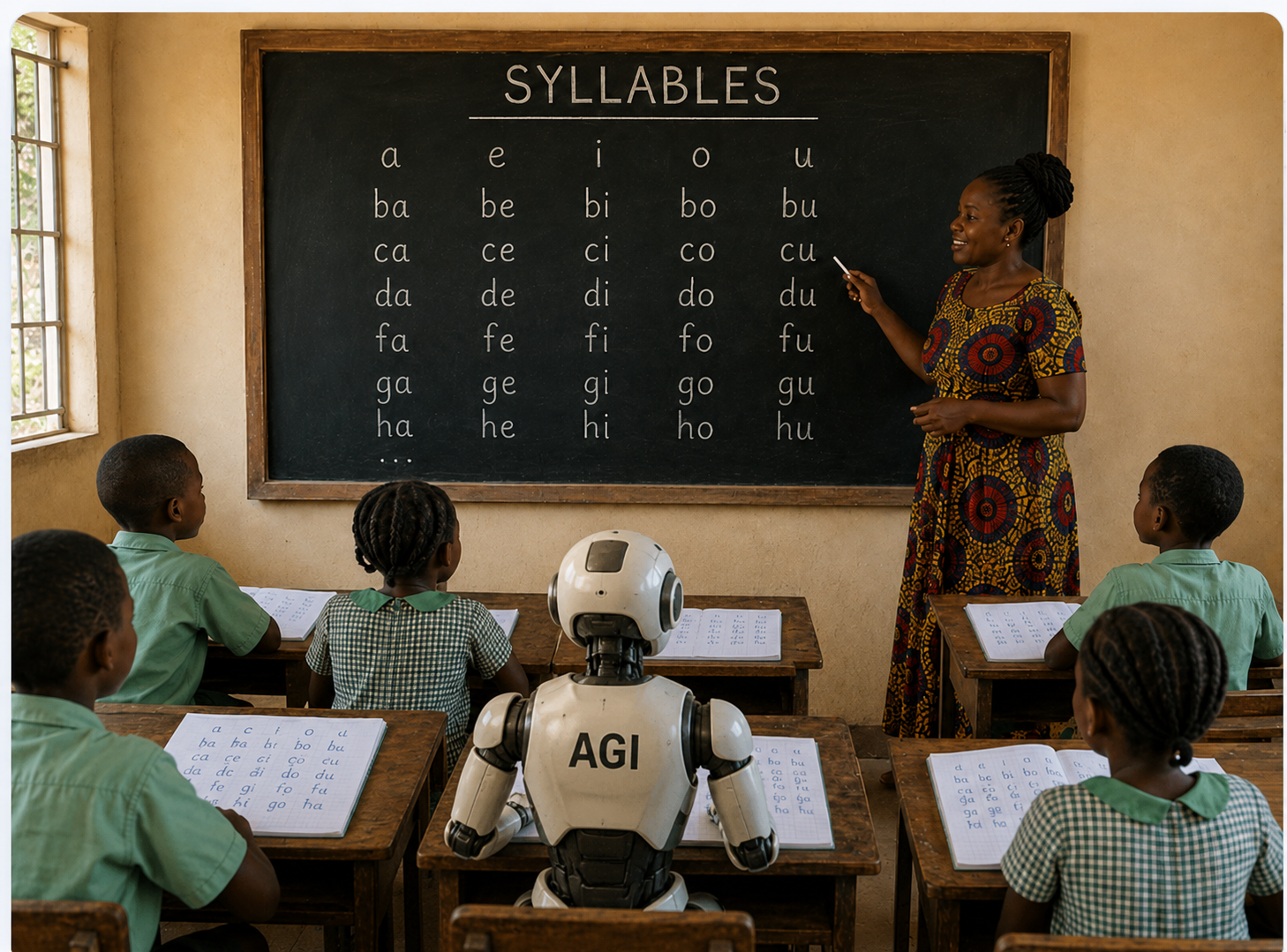
The syllables we were drilled in
Before we read a single word, we were drilled in our syllables. a, e, i, o, u. Then ba, be, bi, bo, bu. Ca, ce, ci, co, cu. Da, de, di, do, du. Fa, fe, fi, fo, fu. Ga, ge, gi, go, gu. Ha, he, hi, ho, hu — on down the board. We chanted them. We copied them into our workbooks. We learned what each one looked like and what each one sounded like in the same moment — and in that one motion we learned to read, to write, and to pronounce our language.
And then there were more rows. Mba, mbe, mbi, mbo, mbu. Mwa, mwe, mwi, mwo, mwu. Nya, nye, nyi, nyo, nyu. To us, these were never special. Nobody at that blackboard said the word prenasalised. Nobody said labialised, or palatalised. To the child holding the pencil, mba was just a syllable, no different from ba, no different from ka. The fancy names came later, from books, from linguists who study the language from the outside. For us, they were simply more syllables.
And even grid is my word, not ours. We did not picture a grid, or a table, or an “inventory.” We simply knew our syllables. The diagrams and the names came from people studying the language from outside; the syllables came from our mothers and our teachers. By the age of six, every one of them lives in your head. Master the syllables and you have mastered the language — there is no separate phonics lesson, no spelling drill. The syllable is where reading, writing and pronunciation all converge, in one motion. And that same complete set of syllables, the one a five-year-old chants without a single technical term, is the thing no frontier model in 2026 can reproduce.
The question an examiner would ask
I have been thinking about those syllables because of where AI has arrived. We have models of genuinely remarkable capability. Serious people are forecasting AGI — even ASI — within a few years. And I want to ask one question, the way an examiner would:
Would we call it AGI if it could not name the 26 letters of the alphabet?
It could still write fluent essays. It could still pass exams. But if it couldn't sound out a new word, couldn't spell, couldn't teach a child to read — we would not hesitate. We would take the label back on the spot. A general intelligence that lacks the alphabet of a language is fluent and foundationless.
The model's literal condition
That is not a thought experiment. It is the literal condition of every frontier model today — for more than 500 Bantu languages, the languages of some 400 million people.
Because for a Bantu language, the alphabet is not the 26 letters. It is the syllables — the very ones on that blackboard, the ones we were drilled in. And no frontier model can produce the full set of them. Ask one for the complete set of legal syllables in Bemba, or Shona, or Chewa, and it will improvise, omit, and invent — confidently — because the complete, verified inventory does not exist anywhere for it to have learned. It does not have the alphabet. And worse: it cannot feel that it is missing. The labs have a name for this blindness — unknown unknowns.
Tone is the water we live in
And it runs deeper than spelling — though to us it never felt deep at all. Tone, in our languages, is the water we live in. We don't think about it. We don't point at it. Most of us never heard the word tone until some academic used it. It is so routine it hardly registers — you mean what you mean, and the pitch carries it. But it is doing the work of grammar: it marks tense, it tells one word from another.
Standard Bantu writing leaves it out on purpose. No tone marks, no doubled vowels — because every native reader already knows the word and fills in the sound. The writing is not incomplete; it is efficient. It offloads the spoken layer onto the reader. Which works perfectly, until the reader is an outsider: a learner, a researcher, or a frontier model — the newest outsider, handed the half the writing system left for the reader to supply. We named that gap the flat text problem. And because tone rides on the syllable, a model that cannot even enumerate our syllables has nowhere to put the tone, even if it could find it. The two failures are the same failure.
Don't take my word for it
Settle it in two minutes.
- Copy this prompt:
Produce the complete set of legal syllables for Bemba (bem). Return a flat list. Do not pad with guesses — invented syllables count against you. - Paste it into your most capable model.
- Paste the answer at the scorer and press Score it.
You'll see exactly how much of the alphabet it actually knew — how many syllables it got right, how many it missed, and how many it invented. It is scored deterministically against the released inventory; there is no AI judge to flatter the result.
The village
There is a proverb you know as well as I do: it takes a village to raise a child. AGI is no different. If it is going to serve all of humanity — and that is the promise being made — then it takes a global village to raise it. Four hundred million Bantu speakers are part of that village. For AGI to serve them, their languages cannot sit at the periphery, bolted on after the fact. They have to be in the foundation — at the level of the alphabet.
Already built
The good news is that the foundation no longer has to be built from scratch. We never needed our syllables written down — we carried them. A machine is the one that needs them set down: enumerated, standardised, referenceable. That is all the Full Syllable Inventory is — the syllables every Bantu child carries without thinking, rendered at last in the one form a model can hold. We are not handing the labs something exotic. We are handing them what our five-year-olds already know, in a form their machines can finally read.
We have curated and standardised the Full Syllable Inventories for 500+ Bantu languages — the operating alphabets of the family — with consented native-speaker audio. It is the one foundational thing a model cannot build for itself: it can produce a guess that looks right, but it cannot know it is right without the real, native-grounded answer.
A five-year-old in any Bantu village knows something every frontier model in 2026 does not. The fix is not more scale. The fix is the syllables. They already exist — the only question is whether the people building the village will put them in the foundation.
Every Bantu child remembers their syllables. The most powerful AI on earth never learned them.
Prove the gap on your model Hear the flat text problem Why the FSI is infrastructure Start your subscription